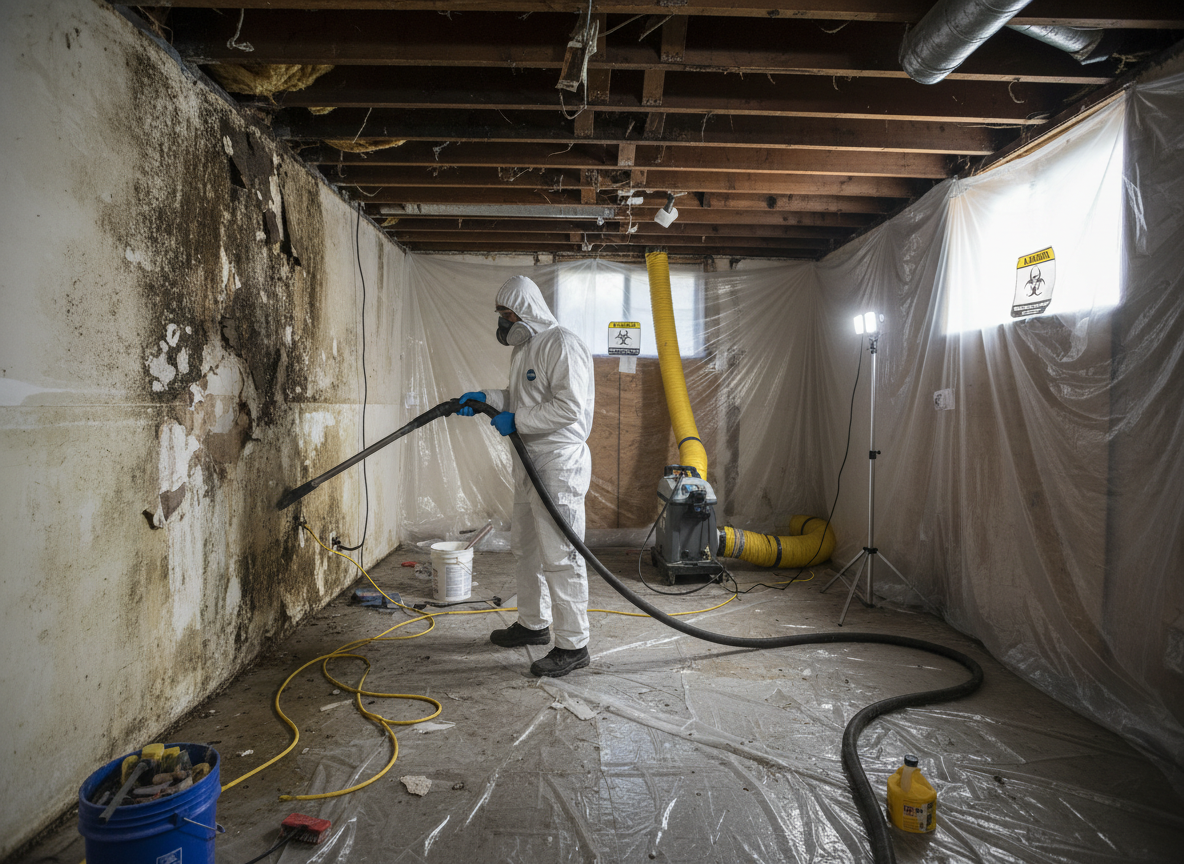
Sunland sits in a Mediterranean climate with hot dry summers and mild winters that still deliver enough rain to overwhelm older gutters and foundations. Many homes in Sunland Village and Foothill Trails date to the 1950s through 1970s and feature stucco over wood framing or raised foundations with crawlspaces. When winter moisture enters these cavities it often stays hidden until musty odors appear or drywall softens. Our crews start with moisture mapping using thermal cameras and pin meters because surface readings alone miss water trapped behind baseboards or under tile in bathrooms common to these homes.
After isolating the affected zone we remove porous materials that cannot be salvaged, such as saturated carpet pad or insulation, while HEPA air scrubbers run continuously to capture spores before they spread to adjacent rooms. In Los Angeles County, any job exceeding ten square feet of visible growth requires containment barriers and negative air pressure to meet health department expectations. We also check attics and wall cavities near Angeles National Forest trailheads where wind-driven rain can enter through roof vents that many Sylmar and Tujunga border properties share.
Drying follows with commercial dehumidifiers sized for the square footage and daily moisture logs recorded until readings fall below 12 percent. Only then do we apply EPA-registered antimicrobials to remaining wood framing and install new drywall or insulation. Homeowners in Foothill Trails often request post-remediation clearance testing because resale disclosures now ask for documented mold history. We provide those reports along with the final walkthrough so the property can return to normal use without lingering liability concerns.
Technician insight
In Sunland, the thing that catches most people out with Mold remediation after water damage is crawlspaces under 1960s homes in Foothill Trails. Winter rain runs down the slope from Angeles National Forest trailheads and pools against the foundation for weeks before anyone notices. Once the floor joists stay damp the mold climbs the rim board and you end up opening twice as much wall as the stain on the drywall suggested.
Hidden Crawlspace Growth After Winter Rain
A Sunland Village homeowner noticed a musty smell in the hallway two weeks after a January storm. We found standing water in the crawlspace under the bathroom where the original cast-iron drain had leaked. After removing saturated insulation and treating the joists, moisture readings dropped below 10 percent and clearance testing passed on the third day.
How it works
- 1
Inspection and Containment
We arrive within hours, map moisture with meters and cameras, then set up plastic barriers and negative air machines to keep spores from migrating through the house.
- 2
Removal of Affected Materials
Saturated drywall, insulation, and carpet pad are cut out and bagged for disposal while HEPA vacuums capture loose spores on remaining surfaces.
- 3
Drying and Antimicrobial Treatment
Industrial dehumidifiers and air movers run until wood and drywall reach safe moisture levels, followed by targeted application of EPA-registered products on exposed framing.
- 4
Clearance and Reconstruction
Independent testing confirms spore counts match outdoor levels, then new materials are installed and the space is returned to the homeowner.
Pricing
Cost depends on square footage affected, depth of hidden moisture, and whether clearance testing is required.